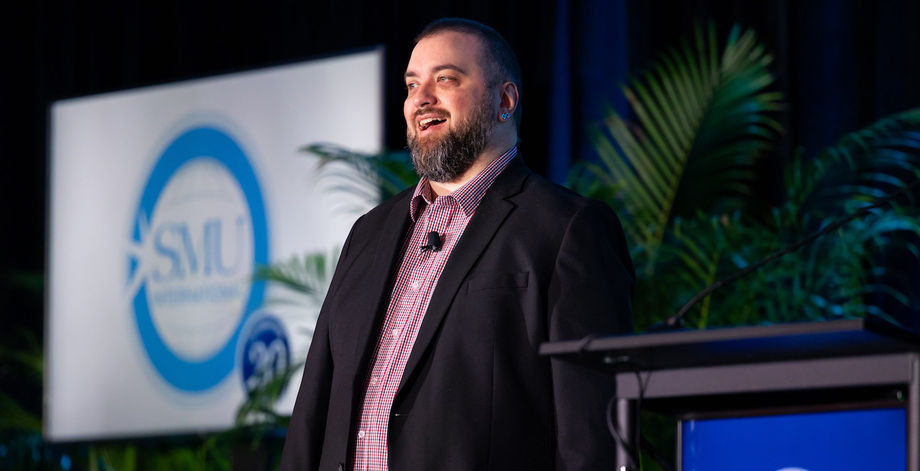
 Nick Borelli at SMU International. Photo Credit:Ketara Gadahn/Studio Alani
AI has pros and cons — both of which will benefit the meetings industry, believes Nick Borelli, marketing director of tech provider Zenus, which is working in partnership with Northstar to bring AI tools and education to our events. When used effectively, AI can harness and enhance the skills of meeting professionals.
Among negative consequences, deep fakes and other AI-enabled false content are eroding confidence in anything we see online. As a result, "In-person meetings will be the only oasis for truth that exists moving forward," Borelli told an audience of more than 400 event professionals during Northstar Meetings Group’s annual SMU International conference this week in New York City.
Here's how AI can benefit the events industry.
1. AI enables fake digital content, making in-person events a crucial source of truth.
When you can create something with your fingertips that looks like you’ve done something you haven’t, meeting in person has an elevated value. People will grow increasingly distrustful of things they see digitally. What we do is much more important, because bringing people together is the only way we can know what's actually true.
Webinar: What AI Means for Planners
Delve more deeply into the specifics of AI uses in the events industry with this highly anticipated webinar, broadcast directly from Event Tech Live in Las Vegas.
Register for free.
2. AI is the bridge from good to excellent meetings.
"I don't think any of you have ever planned an A+ event," Borelli told the meeting professionals in attendance. "Just by a show of hands," he asked, "who here has too much time and resources?" The limits on those two factors prevent us from reaching our full potential, he surmised. "The B+ work you're doing isn't because you don't have experience or because you don’t have vision; it's because you haven't had the time and resources. AI is going to close the distance between B+ and A+."
3. AI is your eager intern, ready to learn from your expertise.
Borelli suggests treating AI as an energetic and eager-to-please intern. Your job is to provide the information it needs to successfully complete tasks for you. "When an intern brings me back something that's not ideal, that's on me because I didn't provide the right information or guidance, said Borellli. In delegating a task to a person, he typically asks, "Is there anything else I can give you to set you up for success?" The same idea applies to prompts. After inputting information, add: "Is there anything else I left out of this prompt that would help you give me better results?" Often a generative AI platform will tell you what else would be helpful to provide a more targeted answer. (Learn more about how planners are using generative AI in the on-demand webinar, "AI and the Business Events Industry.")
4. AI lets you build your own team of "experts."
Borelli works with a number of AI "assistants" that represent different skill sets. They’re named and tabbed in a browser for easy access. "I don't have a lot of human team members. I don't have anyone else to delegate this stuff to," he said, "but I do have an AI designer, an AI copywriter… and so on. It makes me feel good to have a team around me. When I work this way, my prompts might begin, "As if you were my designer..."
5. AI can do things in seconds that would take you hours or days.
With your detailed input, ask AI to build an event budget, create a baseline agenda, match exhibitors with buyers, plan menus and sort satisfaction surveys. You’ll need to tweak those results, but in each case AI has already started the process for you and done a fair amount of the work.
6. AI is a smart repository for organizing your thoughts and ideas.
Think of your prompts as a stream-of-consciousness conversation with a colleague who’s going to make sense of your ideas and objectives, Borelli suggests. "I'm just trying to get everything out of my mind and dump it in there and say 'figure all that out.' And it will."
In that sense, an AI platform can help you reach crucial conclusions. "We have so many details in our heads," he noted. "Just spill it all out, and don't worry about perfection."