 Image by Drobot Dean for Adobe Stock
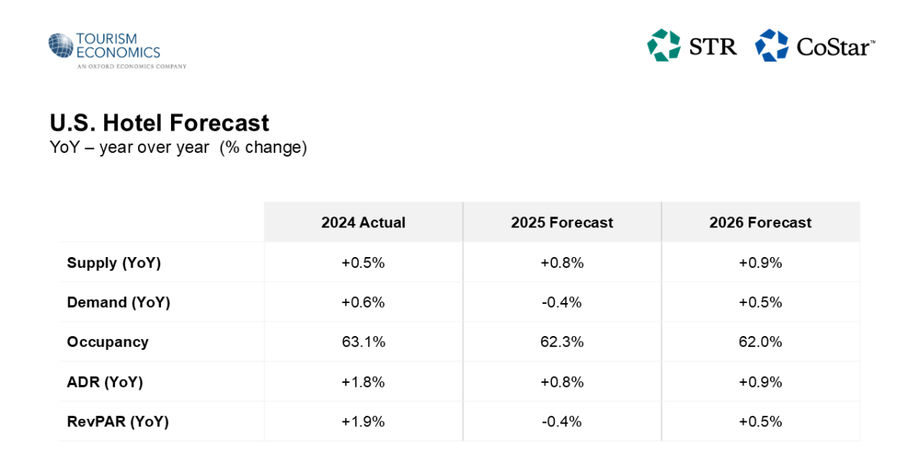
STR parent CoStar and its research partner Tourism Economics further downgraded performance projections in their final U.S. hotel forecast revision of 2025. Average daily rate (ADR) was the only metric unchanged.
For this year, occupancy has been lowered 0.2 percentage points to 62.3 percent, while ADR was maintained at +0.8 percent for the year. Revenue per available room (RevPAR) was downgraded 0.3 percentage points to -0.4 percent. The last time the total-year RevPAR declined in the United States was in 2020 and 2009.
 Source: CoStar and Tourism Economics
Similar adjustments were made for next year, with all three metrics adjusted down: occupancy (-0.3 percentage points), ADR (-0.1 percentage points) and RevPAR (-0.3 percentage points).
"We expect little change in the macroeconomic environment as unemployment and prices continue to rise," said Amanda Hite, president of STR. "As a result, our hotel performance outlook for the remainder of this year and next were lowered once again. ADR is growing well below the rate of inflation, which in turn will put more pressure on margins."
 Source: CoStar and Tourism Economics
2026 travel economy to show slightly positive results
"Job-market softening, policy uncertainty and tariff costs remain near-term drags for consumers. However, heading into 2026, we expect the U.S. travel economy to firm up moderately," said Aran Ryan, director of industry studies with Tourism Economics. "Household income growth will continue, accompanied by tax-cut benefits, resumed hiring and less policy instability. Expanding global long-haul travel and World Cup interest will bring improved international visitation."
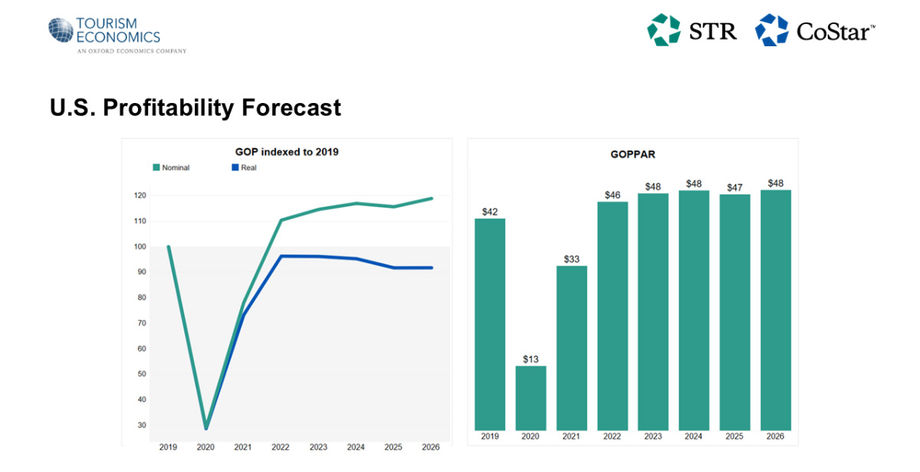
Projections for gross-operating profit per available room (GOPPAR) also have been lowered from our previous forecast, added Hite, with this year's decrease being caused by higher expenses, especially in F&B, as well as increased costs in other departments, such as marketing and utilities. "Labor costs will be slightly higher in 2025, likely due to the increase in the aforementioned F&B department, which is traditionally more labor-intensive," she said.