 Photo Credit:Generated with AI by John Martin for Adobe Stock
Lodging data provider STR and Tourism Economics have revised their U.S. hotel forecast, softening the outlook considerably based on the industry's performance thus far in 2024. The updated forecast for 2024-'25 was released this week at the 46th Annual NYU International Hospitality Industry Investment Conference.
The projected 2024 increases for both the average daily rate and revenue per available room were softened, with ADR downgraded by 1 percentage point, to 2.1 percent growth, and RevPAR pulled back by 2.1 percentage points, to a 2 percent year-over-year rise. Occupancy for the year is now expected to decrease, falling to 62.8 percent vs. last year's 63 percent occupancy.
Looking to 2025, the predicted 63.2 percent occupancy held steady from the previous forecast. ADR was adjusted downward by 0.8 percentage points, to 2 percent year-over-year growth, while RevPAR was downgraded by 0.9 points to a 2.6 percent year-over-year climb.
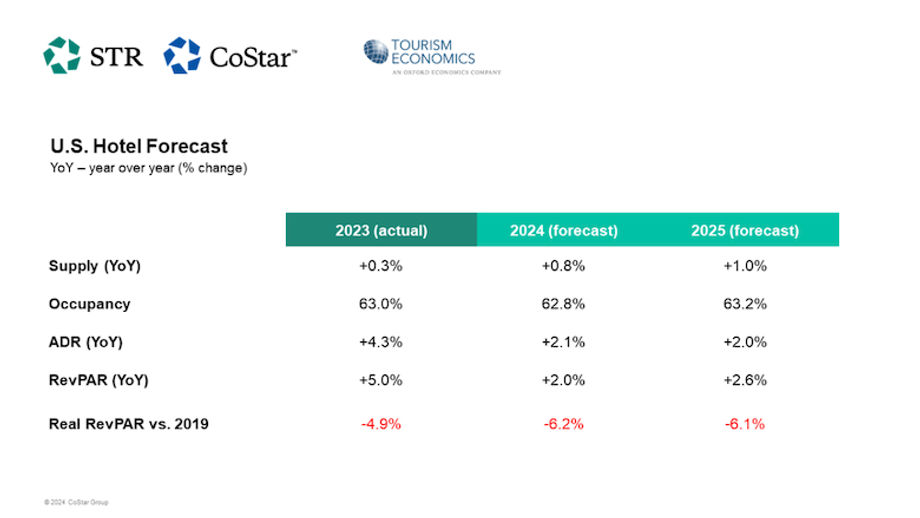 Source: CoStar Group
Leisure travel cutbacks affect demand
Group demand is still strong, according to STR, but inflationary pressures are driving down some types of leisure demand enough to be felt across chain scales. "We have seen a bifurcation in hotel performance over the first four months of the year, which we don’t believe will abate soon," said STR president Amanda Hite. "The increased cost of living is affecting lower-to-middle income households and their ability to travel, thus lessening demand for hotels in the lower price tier. The upscale through luxury tiers are seeing healthy demand, but pricing power has waned given changes in mix and travel patterns and to a lesser extent, economic conditions."
Upper upscale still relatively strong
 Source: CoStar Group
Slight drops in both ADR (-0.9 percent) and RevPar (-0.2 percent) now are being predicted for luxury properties in 2024, while upper upscale are forecast to fare better, with ADR increasing by 2.1 percent and RevPAR by 2.9 percent. ADR is forecast to drop in the economy segment, and RevPAR could decline in the midscale segment.
"Looking beyond this near-term pull-back in demand at lower-tier properties, we expect moderate travel growth to resume, supported by a tempered economic expansion and the continued rebound of group, business and international travel," said Aran Ryan, director of industry studies at Tourism Economics.