 Source:Adobe Stock
Lodging data provider STR and Tourism Economics raised their average daily rate and revenue per available room projections in their latest U.S. hotel forecast update, released today. The revisions from STR/TE are in line with the latest projections from analysts PwC and CBRE, both of which released updates last week.
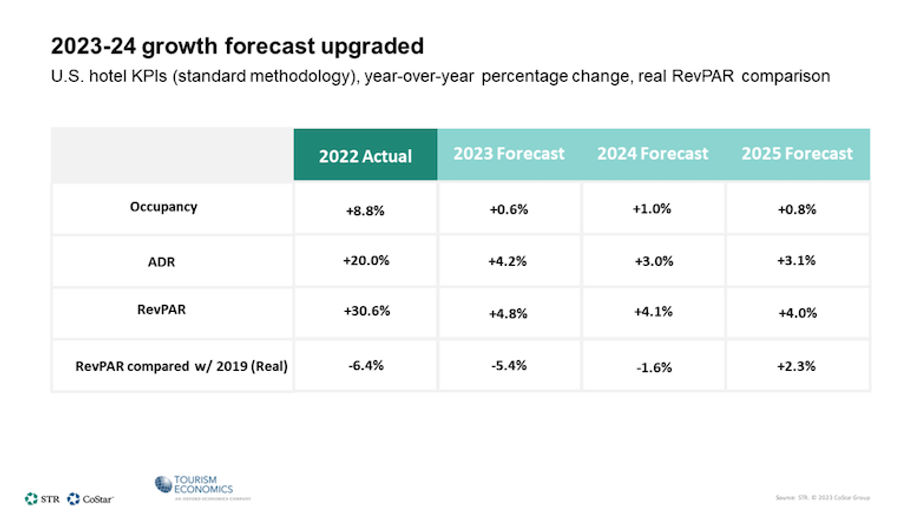
Like PwC, STR/TE slightly downgraded the occupancy forecast for 2023, to a 0.6 percent year-over-year increase, 0.2 percentage points lower than previously expected. But STR placed an even stronger emphasis on the strength of average daily rates, calling for 4.2 percent growth to ADR in 2023. While that is lower than the 4.5 percent increase PwC expects, it represents a significant jump from the 3.6 percent STR/TE had forecast in August.
For 2024, STR/TE does not expect the deceleration in rate growth to be as significant as PwC called for: STR/TE expects ADR to increase by 3 percent next year, followed by another 3.1 percent in 2025. PwC expects ADR growth to slow to 2.4 percent in 2024.
STR/TE now expects RevPAR to grow by a sizable 4.8 percent in 2023, followed by year-over-year increases of 4.1 percent in 2024 and 4 percent in 2025.
"Our latest projections reflect the continued buoyancy of travelers, as room rates outperformed our previous forecast, which built in a mild recession," explained STR president Amanda Hite.
Rate expectations now remain strong despite the lingering macroeconomic uncertainty. "The latest economic outlook calls for a stalling economy with growth well below the levels seen toward the end of the pandemic," Hite continued. "Despite the potential dip, we see strong traveler fundamentals, including low unemployment among college-educated individuals, an increased volume of households above $100k in income, a rise in real personal disposable income and a somewhat stable corporate environment. The projected increase in ADR will result in higher total revenue per available room night, which, combined with less spend on labor, lifts our expectation for gross operating profit as well. The gap in hospitality employment levels, coupled with increased operational efficiencies, brought down our labor cost forecast."
Aran Ryan, Tourism Economics' director of industry studies, acknowledged the negative impact reduced consumer spending could have on hospitality, but credits the meetings market with helping to counteract the effects. "Travel sector improvements, including stronger group activity and returning international visitors, will help offset economic factors, supporting still-solid RevPAR gains," he said.
Real estate and investment firm CBRE likewise credits the expected return of international travelers to help boost RevPAR gains next year — to the tune of a more modest 3 percent gain in 2024, along with a 2.3 percent increase to ADR.