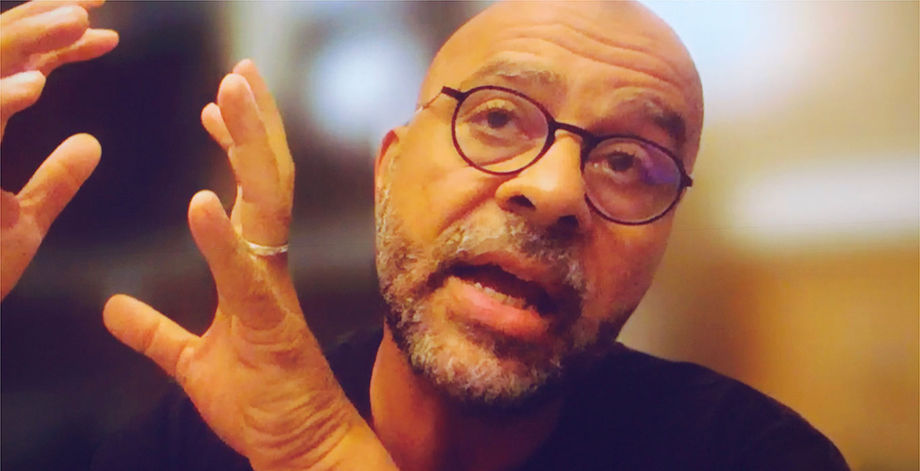
 Photo Credit:Michael J. Shapiro
"I have 15 minutes to talk to you about what I believe is the biggest disruption in the history of humanity by a very large margin," tech guru Mo Gawdat said of artificial intelligence to attendees of the Professional Conference Management Association’s Convening Leaders conference on Monday morning in San Diego. “What we are about to witness — some would say in the next 20 years, but I would say in the next two years — is beyond science fiction.”
Speaking live via video from Singapore, the former chief business officer for Google X told the audience that generative AI will transform not only our jobs but the human experience. The topic is a major theme at this year's Convening Leaders, which is hosting about 4,200 meeting professionals in person and another 700 online through Jan. 10.
When will AI be smarter than humans?
Generative AI gives technology the ability to solve problems and to learn, using data and computing power to evolve without explicit programming. The capability has been germinating since 2000, and gained momentum around 2015, through developments such as Google's Gemini, which exponentially amplified generative AI's cognitive capacities, Gawdat explained.
The next big milestone — the moment of singularity — will be when AI becomes more intelligent than we are. The timeline is a matter of intense debate, though, as some say it AI will outsmart us by 2050, but Ray Kruzwell, considered an oracle of the industry, thinks 2029 will be the turning point.
“I am predicting it's going to be 2025 to 2027,” said Gawdat. In fact, some forms of generative AI, particularly in complex mathematics and deep reasoning, will outsmart humans this year, he added. “By the end of this year, we're going to head into a point where often the smartest person in the room is not a human.”
How AI can enhance human intelligence
Automation is going to magnify our abilities in a way that's going to make everything much, much cheaper, and at the same time, more intelligent and faster. “I want you to start imagining, certainly in 2024, that there is [an outlet] in the wall that you can plug into, and if your IQ is 140, now you can make it 160, and then you can make it 180, by complementing your intelligence with machine intelligence,” Gawdat predicted.
Such AI enhancements have the potential to help organizations gain productivity and reduce costs, but it also means that jobs will change very drastically. “A lot of people are concerned that AI will take our jobs in the future," he said. "AI will not take your job in the next 10 to 15 years, but someone using AI will take the job of someone who isn't using AI, because they will be able to do the job so much better than someone who's dependent on his own intelligence.”
How meeting jobs will evolve
Implications for the events industry span a massive spectrum that could start with simple tasks, such as matching attendees with similar interests or understanding global trends so that you can build events around them, to the complex planning of big events, building in more flexibility and responsiveness.
Anyone who is not at least experimenting with AI should do so now, Gawdat said. "You have to be completely in tune with artificial intelligence. You cannot tell yourself that you're not going to learn this. The easiest way to do that is going to ChatGPT or go to Gemini and tell them, 'I'm in the events industry. What AI should I learn? Start a conversation with it.”
If some of us are going to lose our ability to execute because the world is changing so rapidly, the ones that will go out first are the ones that are not the best at what they do. Focus on your specific strengths, and work with AI to improve in those areas to stand out from your competitors.
While AI can enhance your job abilities, interpersonal skills are more critical than ever. The true advantage in the coming years will be the human connection. "Build your business to focus on that, and I think you will be doing very, very well," Gawdat stressed.
Grooming AI for the greater good
AI learns from humans, and we want it to learn the best traits of humanity, said Gawdat. We are the parents, essentially, of a developing technology that will replicate and amplify our behavior, and we have an obligation to sculpt generative AI's ethical foundation, advocating for a code of conduct rooted in mutual respect.
"Ethics, albeit nuanced and contingent on cultural variations, essentially boils down to treating others — and machines — with reverence,” he said