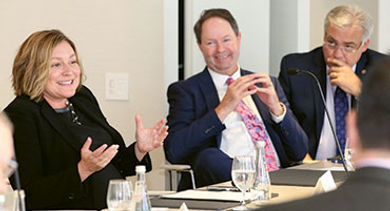
Every year, Incentive gathers a group of professionals from all sectors of the motivation, recognition, and engagement business to talk about the state of the industry. This summer, 12 participants gathered at the spectacular Langham Place, New York, Fifth Avenue to discuss topics including the growing focus on return on experience (ROE) over return on investment (ROI), changing views of the impact of Millennials, and the growing attention paid to security, as well as what's happening in the merchandise, gift card, and travel awards categories. What follows are highlights of that discussion. One additional point: This conversation took place before the devastation of hurricanes Harvey and Irma, so comments in the travel section do not reflect their impact on those destinations.
This is part two of a four-part article. The other parts can be found below, and one-on-one video interviews of Roundtable participants can be found here.
• Part 1: The State of the Incentive Industry
• Part 3: Merchandise
• Part 4: Gift Cards
PART 2: TRAVEL
What Are the Hot Destinations?
Hanks: Florida and California are still having record-breaking years -- that's every year for the last four. One of the most exciting destinations for us right now is actually Los Angeles, because of the number of new hotels. If you go to downtown today as compared to two years ago -- there's a new InterContinental that just opened up which is unbelievable, W's are being built, the whole downtown LA Live is expanding. Off the beaten path, Seattle is one of those next destinations that are becoming hot.
DiGregory: California was in double-digit growth last year. Florida is always good, the Caribbean. We have a lot of luxury brands now, so I just spent the weekend in Vieques, Puerto Rico.
Stagner: The good old standbys in Europe are always popular: Italy, France, and Switzerland. Paris is still super strong for us. Iceland is trendy, it's new, it's hip, it's different.
Athanasiou: We've seen a big push on cruise as well in Iceland.
Stagner: For a lot of customers that we've had for many, many years, it's the same top achievers every year, so you've got to rotate the more popular places, get deeper into those bucket lists. We do some of the really nice boutique properties in the south of France or maybe in Tuscany. In the wine country that is a more unique boutique experience.
Smith: A hot new destination is Croatia, which is really popular for us.
Stagner: We're really seeing an uptick in Slovenia -- one of the reasons is that Slovenia is rated one of the safest destinations in Europe. It's also this untouched, special place that you really can't find in Europe anymore.
Smith: And I see destinations within destinations. For example, not just Italy, but Puglia. That is not a region that most people are familiar with, but they love Italy and have been there a million times, so they are willing to try Puglia.
Athanasiou: That is why river cruises have become so popular over the years. You are getting into smaller ports that often don't have the hotel infrastructure to support the number of rooms that you need. It's a great taste of a region or a smaller, harder-to-get-to destination. The three Ritz-Carlton yachts coming in 2019 are being built specifically for that reason: To go into the ports that the bigger ships can't.
Stagner: Mexico continues to be super strong for us, no problems at all. We continually use Cabo, Punta de Mita is fabulous, and a Fairmont is opening there as well. Riviera Maya--Cancun continues to be popular. Depending on what coast you are coming from, or the Midwest, Mexico continues to be in the top three to five destinations for us.
We aren't seeing much of the super long-haul, and it is strictly because of the flights. Our programs are actually shorter than they used to be, so we tend to do more Europe, Caribbean, Mexico, Costa Rica, versus going all the way to Australia or New Zealand. Traditional Asian destinations like China, Hong Kong, Thailand are not considered so much, unless winners have a portfolio of trips to choose from. If it is just one trip, Asia is not going to be on the list, and most of it is the long-haul flight. For our well-traveled groups that have a choice, we would put in a Vietnam or something more off the beaten path like Bali, in Indonesia.
Athanasiou: I think airlines are impacting travel. With a lot of customers, the cost of air travel is dictating the type of program and experience that is going to be created. Whether it's hotels, destination management companies, cruise lines, you name it, we have to finagle budgets based on what the airline cost is. It can be frustrating. I haven't heard a lot of noise about customer service. It's more about making sure they can get people there without having three connections.
Stepping Up Security
Athanasiou: I would say we hear a little bit more about the potential security risks/concerns. That question comes up more than it does not, and so in dealing with that it's been more about having conversations about it and getting the end user and their internal channels more involved in the discussion, the risk mitigation and plan. I think those conversations are happening more than they have ever happened before, so that has become common for us.
Stagner: Maritz Holdings has been around for over 100 years, and we've been a travel company over 60 years. We have had emergency preparedness plans for as long as I remember. Most times, the clients never cared to even ask about it. They just said, "We know you've got it, we're fine, if there's a hurricane, if something happens, we're handled." We've talked about it more in the last year than we ever have. The other thing we're seeing from our customer base is resilience. They're saying, "We want to know you're prepared, but we're going to do this. We're not going to stay at home and say 'I'm never going to get on a plane again.'"
The reality is, it doesn't matter where you are anymore, something can happen absolutely anywhere. And we don't talk about it just with our customers. We're pulling in our destination management company partners, our hotel partners, our cruise lines -- it is a very open conversation. The Association of Destination Management Executives International has a formal [Emergency Preparedness Certificate] now, which is wonderful.
Incentive Cruising
Athanasiou: Domestically, the Caribbean, Cuba, and Alaska are our top three destinations. On the Norwegian Cruise Line brand, we have a ship that's based year-round in Hawaii. We do a ton of business on that because we are the only ship there. Our Cuba business is insane, our occupancy is off the chart. We just pulled another ship to go to Cuba year-round now, so we will have two on Norwegian brands, and Oceania does it seasonally on Oceania Cruises, and one on Regent Seven Seas Cruises.
Internationally, Iceland is probably top three. I would say then, both the Western and Eastern Mediterranean. We made the business decision to pull out of Turkey a couple of years ago, but groups still want to go east, so they are going as far as they can in the comfort zone, which is typically Greece. Then, oddly enough, places like the western coast of Spain all the way up through Amsterdam. You're getting a little bit of Denmark, a little bit of Germany, a little bit of England, and even some of Ireland and Scotland. That whole region has been very popular for us.
Many hotels are now including Wi-Fi and insuring that the connectivity needs can be met. It's become almost an expectation. Ships across the whole industry are investing millions and millions of dollars to try to keep up with the demand. The reality is we are still working with satellite constraints, but on some of the newer vessels that are coming out of the shipyards, the technology is night and day from what it was even three years ago. Some brands are now completely inclusive of unlimited Wi-Fi.
Switzerland
Pidroni: Switzerland has the advantage of being small, but we have so much to offer. It is a very diverse country. You have the high adrenaline -- if you want to go and do the James Bond bungee jump, you can do it -- but if you just want to do an easy horse-carriage ride up the mountain and enjoy a little shopping once you get there, you can do that, too. It is one of those countries where, in some places, you can easily be down by the lake surrounded by palm trees in the morning, and by lunch time you can be up in the mountains by a glacier. While you do that, you can do your traditional cheese, chocolate, or wine tastings.
But the beauty is that there is way more to Switzerland than these clichés. If a group wants to experience something more unusual and different, for example, in Geneva, you have CERN, where the World Wide Web was created. You can take a group there, but you can't go on your own. And there are all of the different industries that we specialize in, not just banking and finance, but pharmaceutical, technology, and others.
Talking about perception and pricing, Switzerland is not cheap, but it's a very competitive destination. Airlift-wise Switzerland is great. We get more and more direct flights. We have Vegas direct flights, we have really good access from the East Coast, 7.5 hours. It's super-fast to get there, and then to travel within Switzerland is fast. You can go from Zurich to Basel in an hour, Zurich to Berne in an hour. An exciting new project happening in Switzerland, we will get a new hotel in 2020. It will be in Zurich, and it's going to be a Hyatt with 550 rooms -- the biggest in Switzerland.
Puerto Rico
Segarra: In Puerto Rico we have, like, 10 top-of-the-line, super-luxury properties, amongst them the W Retreat & Spa-Vieques and the Dorado Beach, a Ritz-Carlton Reserve -- a phenomenal product. Obviously, San Juan is by far the most important tourist destination for Puerto Rico. It is nice and very different and authentic. In two hours, you can get to a beautiful mountain, pick your own coffee, and take it home with you.
Let me mention a couple of facts about Puerto Rico. The impact of the incentive segment in Puerto Rico is the most important thing. Just to give you an idea, a group room-night in Puerto Rico has an economic impact of $874. When you go to a corporate group, it's around $1,000 per night. When you get to the incentive, it's $1,387. You can see why a destination wants to make sure it's prepared to take care of that particular business. The incentive is right on top, leading the pack.
Las Vegas
Meyer: We hostedver 22,000 events last year, most of them less than 200 people, and incentive is an important part of our mix. The group size hasn't been large -- it's been 20 to 50 people, but very, very focused and very high level: typically, director to senior-level executives. And it's all about the loyalty to the brand that's generating that particular incentive.
It brings some really great opportunities for us and allows our property partners to really do some unique things experience-wise. There is more opportunity to create greater and more diversified experiences than just about anyplace else on planet Earth. I've got a billionaire developer who is building a beach on his golf course that will be opened by 2020 -- Wynn Resorts just announced their Wynn Paradise Park concept geared at that younger, more affluent traveler. That is what the Wynn is about, ultra luxury.
You are going to see a very dynamic shift in our destination marketing over the next three to five years, because the sports world has discovered Las Vegas in a large way. The Vegas Golden Knights will play their first season this October. [The Oakland Raiders arrive in 2019, and] in August of 2020 will be in a brand-new, 65,000-seat domed stadium -- not retractable roof, by the way, just domed -- but the way they are designing it, you will be able to open the sides and have fresh air.