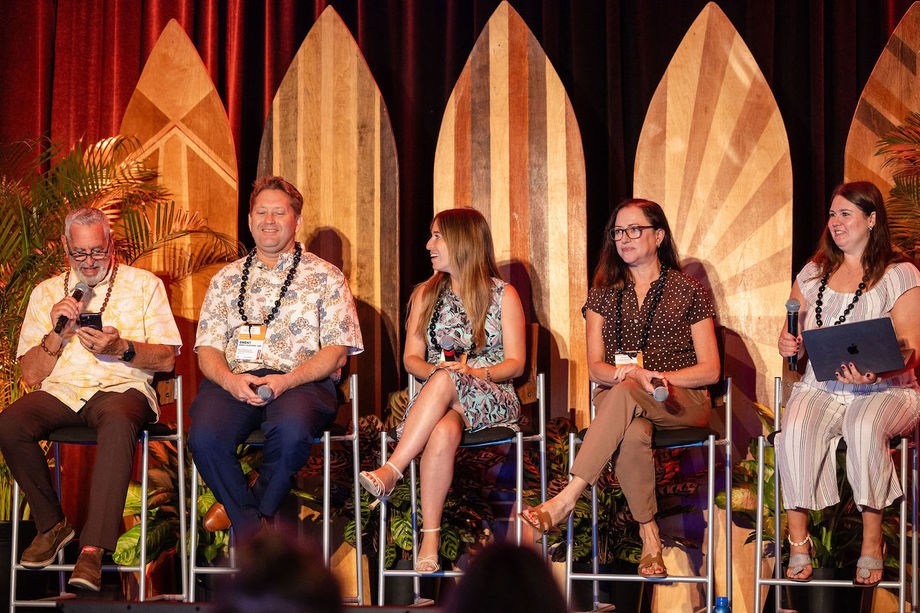
 From left to right: Bob Lowell, Brent Lausterer, Allison August, Tina Giangiacomo-Yogya, Lizzie Wilcox. Photo Credit:Kimberlee Aihara, Aihara Visuals Photography
Northstar Meetings Group events afford unique opportunities to glean insight from leaders across the meetings ecosystem. At Destination Hawaii, we gathered an assortment of event leaders to address their fears, challenges and tips — particularly during times of uncertainty and, in part, through the lens of a destination having recently recovered from crisis. Participating in the panel were: Allison August, assistant director of group sales at the Wailea Beach Resort - Marriott, Maui; Tina Giangiacomo-Yogya, founder and director of events at SF Bay Events; Brent Lausterer, director of sales for the Maui Visitors & Convention Bureau; and Bob Lowell, owner of Kōkua Destination Services.
Panelists weighed in on the state of the industry, the fallout and recovery from the devastating 2023 Maui fires, how to positively impact host communities, and more. Responses have been edited for brevity and clarity.
What's the number-one thing keeping you up at night?
Brent Lausterer, Maui CVB: Following the Maui fires, a lot of mixed messages were sent out and people have questions. I think the biggest thing I've come to hear from people is how do they return, how do they respect the land and know that they're doing the right thing. [What keeps me awake] is making sure we're getting the message out from an operations and logistics standpoint is that Maui's fine. The things that always have attracted people are still here: the natural beauty, the culture, their favorite spots. There's just so much good energy on Maui and it's so important that people understand that travelers of all types are welcome.
Bob Lowell, Kōkua Destination Services: One of the things I lay at night thinking is, "Is your business going to continue to come to Hawaii?" We're expensive, it's always been, but the reality is everywhere is expensive. So do you remember Hawaii? Do you remember the experience your guests had in Hawaii? What's that worth?
Allison August, Wailea Resort: It is such a fascinating time right now
globally, politically, economically, environmentally. We're really
starting to see the pricing in Hawaii normalize, and I wonder, "Do
people know that?" The experience in Maui is better than ever in terms
of both infrastructure and just general experience, so what keeps me up
at night is making sure our associates are supported and our resorts are
full.
Tina Giangiacomo-Yogya, SF Bay Events: One of the partners [of a past
client] asked me to find a helicopter that could fly him over
Yellowstone. During migration season you can't do that, and there's no
one allowed to do this. But I found somebody in Montana who was a Black
Hawk helicopter pilot that picked us up in Wyoming and flew us over
Yellowstone, only in one direction because you can't turn around, you
can't mess with the migration. And so year after year, I'm still trying
to figure out how I can top that — on a little budget.
If you could sum up the state of the industry in a word, what would that be?
Lausterer: Evolving. There's been so much happening with technology and how we bring technology into our internal processes … just the constant movement and adoption of technology.
August: I have to second what [Brent] said, I really think the best word to sum it up is "change." Within our little sales team here at the Wailea Beach Resort, our theme of the year is "shake it up," just trying to stay ahead of the curve. There's so many factors changing: technology, AI, we're seeing different types of companies coming to Maui that are looking to host incentive trips here. So we know we have to evolve and continue to take care of our customers and sometimes that looks different.
Giangiacomo-Yogya: Transformative – the same thing of change. It's really going in that direction with AI and everything changing so rapidly, and keeping ahead of the game on that.
Lowell: In Hawaii there's basically three languages: there's Olelo Hawaii, which is the indigenous language of the people of Hawaii; there's the Queen's English or King's English, which most of you are speaking; and then there's Hawaii Pidgin. Hawaii Pidgin is a queer language made up of many languages that comes from the captives and Asian slaves. So the word that I have selected to sum up the state of the hospitality industry is futless, which translates to uncertainty, antsy, uneasy. We're uncertain about what's going to happen, we're uncertain about how progress is going to take place in Lahaina and we're uncertain about the business continuing to come to Hawaii.
How is artificial intelligence impacting meetings and incentives?
August: We are seeing different types of companies looking to come to Hawaii, new AI companies that are looking to host incentives, things of that nature. In my day-to-day job, AI helps me complete tasks so much quicker and I find that I have so much more time to engage better with clients and be creative and improve the guest experience.
Giangiacomo-Yogya: I use it all the time, it's a really important tool. I think that attendee engagement has changed because you can now match people … so when they get together, they have those meaningful connections at events and they really connect with people that have their same interests.
Lowell: It's interesting … AI creates experiences that don't necessarily exist. They're conceptual, but in many cases impractical. "Where did you hear about that where you can go up and actually hike down into the volcano while it's erupting?" "Social media!" AI is great in theory but not as factual as actual boots-on-the-ground experiences.
What can we do for CSR that feels real and authentic?
Giangiacomo-Yogya: I think it really goes to the values of the company that you're working with to see what they are interested in. Open up that question to everybody, "What would be meaningful for you?" and really have the partners be involved in that because you want everybody to be excited about it. There's so many great ideas that I've seen out there that are wonderful. For me personally, I'm a 10-year wish-granter for Make-A-Wish, so I've done walk-a-thons with different companies and the fact that they can see how much money they raised and then see the child that they've given this incredible wish to and have that come full-circle has been really meaningful to them.
Lowell: We say, "Malama aina, malama pono;" Take care of the land, the land will take care of us. So anything that we can do with our guests that are coming to Hawaii that can help the land. We're in a huge drought, as you've noticed how dry everything is. The land is in desperate need of help. The Hua Momona Foundation in Kapalua is still distributing food to this day to Maui fire survivors who still don't have enough to eat.
Lausterer: DMC and CSR partners can offer activities that are fun well as helpful. Among them are Seeding the Future and a project the Maui Ocean Center is working on for limu [seaweed] restoration. And then there's other things that are not nature-focused, but people-focused: Boys and Girls Clubs, Rotary Club, there's so many different partners.
Where are you feeling the financial squeeze the most?
Giangiacomo-Yogya: Food-and-beverage usually, that's just kind of across the board I think with everyone.
August: We're behind pace for groups for 2026 and in order for this resort to perform optimally, we need a really solid group base.
Lowell: Where DMCs are really suffering is what's left in the pocket. We know with lower hotel occupancy that any property needs to go up [in rate] to compensate so owners are paid and stockholders are satisfied. The rate is accelerating so it's taking a big chunk out of the budget. Unfortunately costs are going up, food's going up, operating costs are going up. So the shortfall falls on the DMC, which includes transportation partners, event partners, entertainment partners, staffing partners and food-and-beverage partners for offsite events. We love to provide the experience, we're the experts at that. Give us the opportunity when you're doing budgets, talk to us, help us to help you in that process and we'll stretch your dollar.
What is one thing you would change about our industry and why?
Lowell: We have 1.4 million people in the state of Hawaii and two-thirds of that work in the hospitality or tourism industry. Since Covid we're still recovering, in some areas we're still down 45 percent. We're behind pace and we need your business.
August: From a hotel standpoint, I would love to see more groups and companies that are willing to book multi-year business. We can provide such amazing value if you can book two years with either the same hotel or two years within Marriott. So just finding more groups that are open to that, it can be really beneficial for them.
What is the best thing that has happened at a recent event?
Giangiacomo-Yogya: I have this tech group every year — big incentive group, about 500 people — and they've always focused on virtual reality. They wanted to do something different this year to bring back old-school fun so participants were more engaged with each other. They had a talent show and it was the most fun thing I've ever seen. Some of these guys don't even leave their houses and the talent that they showed on stage…really brought them all together.
August: We recently hosted an event at our property; it was a three-day event and the programming was so incredible and fun. The first night at the Nalu pool with the tall water slides we had an afterglow with amazing up-lighting, and the general manager ended the night going down the water slide in her beautiful dress. And then the next day I'm sitting at Olakino pool getting a massage in my lounge chair and watching whales breach. And then to end it, on the third night, we were toasting champagne at the ocean's edge and it was just incredible.
Lausterer: I was at an event recently where our CEO Aaron Salā spoke. The phrase "regenerative tourism" is one that gets used a lot and I think it's a little unclear. A lot of times people think of the physical elements of conservation: beach cleanups, plantings, things like that. But in this session, he expanded it to really talk about how regenerative tourism is when visitors come and — in an organic way — feel connected, feel engaged to the cultural place they're in. He said that with regenerative tourism, when visitors come and when they leave, they've got a sense of the stories of the people living there … and their world. One of the most important things to know is that Hawaiian culture is a living culture. And what makes it so passionate is that it's being carried forward by each generation. I really loved that because I thought it expanded what regenerative tourism can mean for the visitors and for us, who are bringing them in.
Lowell: We just worked with a medical license company who came to Wailea in 2016. This company never repeats a destination. But the client reached out and said, "I love Hawaii, what can we as a company do to help West Maui?" They ended up hosting their program on the west side and participated in CSR activites. They all wore red shirts with #LahainaStrong, which is symbolic of the Lahaina fires and the recovery effort…What they didn't know was that for the final night, we bought out a restaurant and at the conclusion, had a local musician who wrote a song called "Lahaina Strong." He started to perform his song and after he did the first chorus, the kids from the Lahaina High School choir, all who had lost homes and some family members in the fires, came into the room all wearing Lahaina Strong t-shirts. After their performance, there were many tears in the audience and a standing ovation. That moment will resonate with them forever. The aloha spirit was truly perpetuated that night.