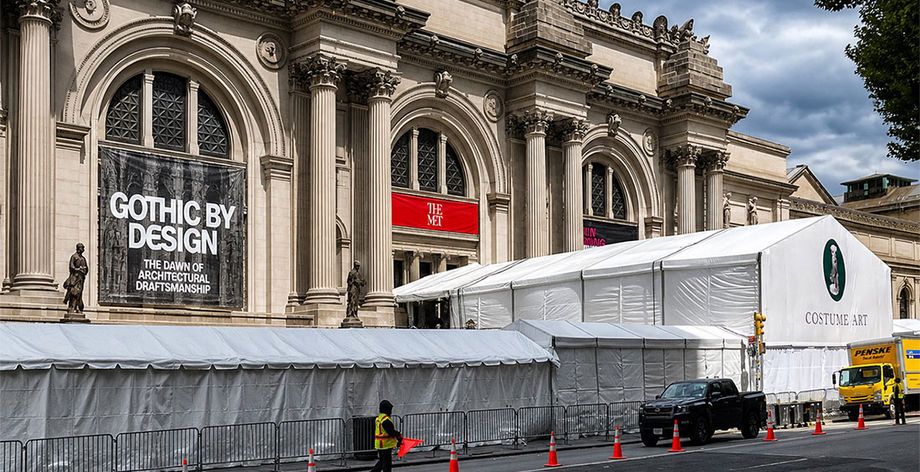
 The Met Gala tent is ready for arrivals. Photo Credit:Vincent Alonzo
On the first Monday in May, New York City's Fifth Avenue becomes less a street than a stage set, a canyon of barricades, camera flashes, security details, black cars, impossible gowns and practiced suspense.
The Metropolitan Museum of Art might be the official venue of the Met Gala, but the event begins long before anyone reaches the museum doors. Under
a gleaming white tent of privilege and choreography, celebrities step out of SUVs, ascend the carpeted stairs, pause for the ritual flashstorm and briefly turn crowd control into culture.
For the public, the Met Gala is about who wore what. For meeting and event planners, it is about something else entirely:
how it all works.
Canvas with benefits
At the 2026 Met Gala, the signature white tent rose in front of the museum, setting the stage for the event and signaling this year's theme, "Costume Art." What appeared to be a temporary structure was actually a highly engineered, interconnected environment.
The tent that climbed the Met's iconic steps and spanned nearly two full city blocks created dedicated zones for media, security and the VIP celebrity guests who walked the red carpet beneath it in a seamless extension of the venue. It was designed to
control the flow, the environment and experience at every touchpoint.
That distinction matters. According to Jaclyn Bernstein, president and owner of Empire Force Events, a temporary structure can extend a venue, reshape the attendee journey, create anticipation and help guests cross a psychological threshold before the program officially begins.
"The tent is not the prefunction space," she says. "It's the first act."
Don't just pitch a tent — pitch a story
While most corporate groups are not producing Met-level arrivals, Bernstein says the idea of the Met Gala has become a reference point for clients who want their own version of drama, anticipation and spectacle.
What the Met understands, she adds, is that much of the attention surrounding any event is concentrated before anyone gets inside. "It's all about that entrance," Bernstein says. "Planners need to decide what the guests are supposed to feel the moment
they arrive. What is the tone before they enter the ballroom? The question is not whether every event needs a tent. The question is whether every event needs a better threshold."
Bernstein urges planners to think beyond conventional tenting. Temporary structures do not have to mean poles, canvas and a peaked roof. They can include stretch fabric, greenery, tunnel effects, entertainment, hedge walls, branded pathways or other built
environments that create separation between the everyday world and the event world. "There's a lot of stretch fabric material that many times can create a tunnel effect," she says. "We've done it with greenery where the guests are walking through
something that they would not expect to see."
The structure can be outside on the street, inside a foyer or embedded within the venue. Bernstein says her team has even created a Studio 54–style entrance in a foyer, making it feel like guests were standing in line on the street, seeing who was
there and becoming part of the social theater before entering the event. "We can create an entrance anywhere," she notes.
Lean into roughness
Greg Byrnes, senior director of strategic accounts for One10,
has seen that principle play out far from the Met Gala, in a very different New York setting: the industrial waterfront of Greenpoint, Brooklyn.
For a financial company's employee-recognition program, Byrnes helped transfer more than 100 guests from Williamsburg to Greenpoint by water taxi. The destination was the kind of waterfront infrastructure New York has in abundance and rarely beautifies:
old piers built for shipping. "The piers and loading areas are not the easiest on the eyes," Byrnes says. "We are talking about century-old structures made for shipping, manufacturing and true industrial ecosystems."
Instead of hiding that roughness, the event leaned into it. The arrival became a narrative device. Guests came off the water taxi and moved through a welcome path designed to illuminate Brooklyn's past, present and future. Nathan's hot dogs created a
boardwalk-like entry. Pop-up artists danced and sang as attendees made their way toward the reception space in a restored rope factory. Live graffiti artists worked on-site, echoing the surrounding warehouses already covered with local displays of
"emotion, diversity and education," as Byrnes describes it.
One important yet simple design choice was to staff the welcome path generously. "It was almost like finishing a marathon," he says. "We wanted to give attendees a sense of accomplishment and award." Two lines of local New York staff celebrated and welcomed
guests as they arrived.
The intent of the tent
The Met Gala tent works because it is both practical and wildly symbolic. It protects people and product. It controls media and movement. It creates privacy in the middle of Manhattan. It turns a museum entrance into a ceremonial runway. It makes the
outside feel like inside and the inside feel more anticipated.
Most meetings will never need that level of production. But they can borrow the thinking.
It's important to use temporary structures only when they improve the journey. If a tent helps control flow, lighting, privacy, security, branding and atmosphere, it might be a strategic choice. If it simply creates another bottleneck, build the experience
another way.
And above all, know what that moment is for. For Byrnes, that means designing around the attendee's full journey. For Bernstein, it means understanding the emotional weight of the entrance and making sure it connects to everything that follows.
Vincent Alonzo is a journalist and storyteller who has covered the meetings, events, conventions and incentive travel industries for more than 30 years.