 Photo Credit: heychli for Adobe Stock
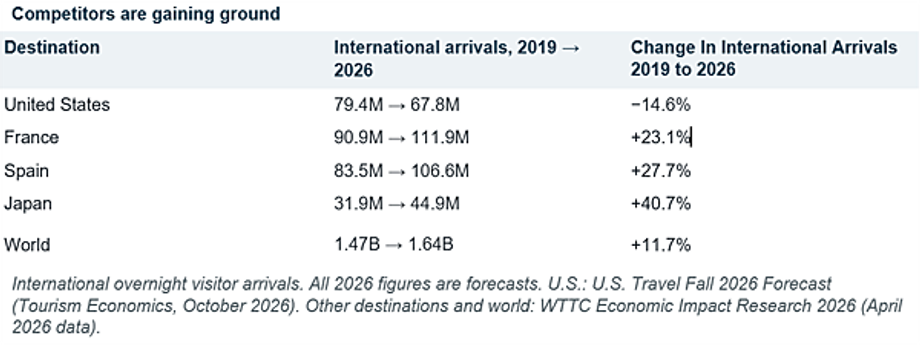
A new U.S. Travel Association forecast puts the United States' travel slowdown in stark figures: International-visitor spending for 2026, adjusted for inflation, is projected to decline nearly $11 billion, a 6.3 percent drop to $163 billion. Even with a record 2.44 billion domestic trips expected to take place this year, total inflation-adjusted travel spending in the country is projected to decline 0.7 percent to $1.35 trillion.
Travel prices are projected to rise 7.2 percent in 2026, more than twice the expected 3.4 percent rise in the country's overall inflation. At this point, U.S. international arrivals are not forecast to recover to 2019 levels until 2030, and the United States' share of global long-haul arrivals has fallen from 10.3 percent in 2019 to 7.7 percent in 2026 and is projected to slip even further to 7.1 percent by 2030.
"The election is over, but the economic stakes are only getting higher," said Geoff Freeman, president and CEO of U.S. Travel, a nonprofit organization that represents all components of the U.S. travel industry. "Travel supports American workers and communities. Congress has a December deadline to protect holiday travel and a new year to reverse the loss of international visitors."
 Credit: U.S. Travel Association
Economic stakes are high — nationally and locally
Currently, travel supports more than 15 million American jobs and generates $92 billion in state and local taxes. Following a September meeting with President Trump at the White House, travel industry leaders proposed a national goal of welcoming 100 million international visitors annually by 2030. According to U.S. Travel, achieving that goal could generate $68 billion in additional annual visitor spending and support more than 350,000 additional jobs. The projected $11 billion year-over-year spending decline represents the economic activity that is at risk across visitor-serving businesses.
A good microcosm is New York City, where international visitors represented roughly half of its tourism spending in 2025; all tourism supported 397,000 jobs and $7.5 billion in tax revenue. These numbers are at risk as international inbound travelers decide to travel to other countries, instead. Other gateways — including Miami, Los Angeles, Orlando and San Francisco — also depend on high-spending overseas guests.
Congress has a near-term test — and a longer-term mandate
Similar to a call for action from the Exhibitions & Conferences Alliance, U.S. Travel is urging Congress to act for a short-term benefit and to work on long-term solutions to turn the international visitation numbers around.
Before Dec. 11, U.S. Travel calls on legislators to set aside government funding and enact lasting protections so Transportation Security Administration officers and air-traffic controllers receive uninterrupted pay during future federal-funding lapses, reducing the threat of airport disruptions and travel chaos during the holidays and after Congress changes hands in January.
For the future, the association calls for the reauthorization of Brand USA, the nation's destination marketing organization, and to restore its full funding. U.S. Travel also wants Congress to expand visa-processing opportunities and to eliminate recent unnecessary visa fees, as well as other entry barriers and the uncertainty they cause.
The organization also urges an acceleration of investments in air-traffic control, where staffing continues to be a major issue, and in airport-security modernization.
"The current Congress must keep America moving this holiday season. The next Congress must help America compete," Freeman said. "We have the opportunity to deliver a better travel experience for Americans, and to bring more international spending and jobs back to our communities. Standing still is not a strategy."