This has been a year marked by tremendous uncertainty, geopolitical tensions, and wildly shifting sentiments among meeting planners. As it stands now, those sentiments continue to shift back in a positive direction. It seems the longer planners have had to deal with continued uncertainty, the more optimistic, on average, they have become.
The overall theme of this season's collection of industry forecasts? Growing but measured optimism, with plenty of caveats.
"It's partly cloudy," said Michael Dominguez, president and CEO of Associated Luxury Hotels International, in an industry outlook session he presented at a Northstar Meetings Group event in October. "It's been a hard year to get through, with a lot of chaos and a lot of uncertainty, but overall, let me tell you, we're doing OK."
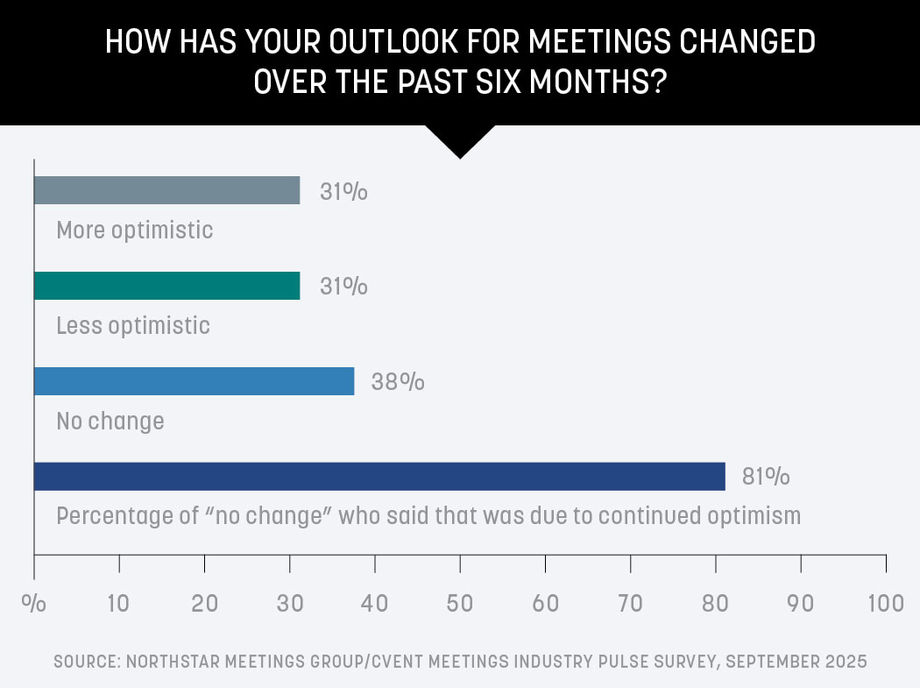
That outlook is reflected in the Northstar Meetings Group/Cvent Meetings Industry PULSE Survey. According to the latest North America edition, released in late September, planner optimism continues the upward climb from the precipitous drop it took last March. While still markedly lower than last October's levels, the number of planners feeling more optimistic now than six months ago has grown; the vast majority of planners who say their outlook hasn't changed attribute that to continued optimism.
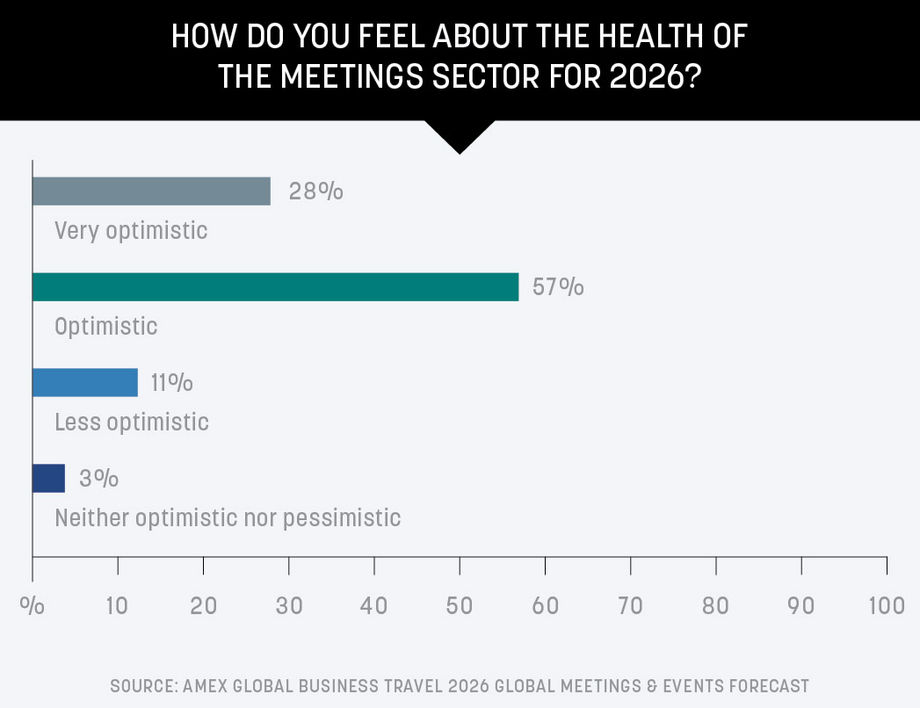
The global outlook is even sunnier, according to American Express Global Business Travel, which finds optimism to be at a five-year high. According to its Global Meetings & Events Forecast 2026, an impressive 85 percent of event professionals are either optimistic or very optimistic.
Proving resilient and stable
Amex GBT attributes the optimism, in part, to the fact that the meetings sector has stabilized after a decade of unpredictability and change. Despite this year of general economic uncertainty, the events industry is demonstrating a consistency and resilience that meeting professionals weren't previously sure they could count on.
"We had this great pause between April and July where nobody knew [what was going to happen]," Dominguez pointed out. "We just felt anxious. And now what you're seeing is everybody's coming out of the fog, and we're starting to move again because we're realizing it wasn't as dramatic as we thought it was going to be."
The Northstar/Cvent PULSE Survey reflects this stability as well, beginning with strong booking activity. Planners are sourcing and booking meetings at the same clip they were a year ago. The percentage of respondents who aren't currently planning meetings is the lowest it's been in three years. That bodes well for the year to come.
What's more, the perceived value of face-to-face meetings compared with other business initiatives is remarkably strong across the globe, according to Northstar/Cvent PULSE Survey data in the North America, EMEA and the Asia-Pacific regions. More than 70 percent say that events are either somewhat or significantly more valuable than other such initiatives.
Of particular interest to planners is the fact that their attendees just might be more optimistic than they are. According to Freeman, the full-service event management firm, its recent trend reports show attendee sentiment is significantly higher, on average, than it is for those planning the events.
"We're seeing planner sentiment crawl back up," explained Ken Holsinger, Freeman's senior vice president of industry research and insights. "But attendee sentiment has been significantly higher. There is still a gap of more than 50 percent between what the attendees say is their future view vs. what the planners are saying. I think the message I would have is that the attendees feel better than we do, and maybe that should further lift our optimism."
Modest price increases ahead
The volatility of event costs over the last several years has taken its toll on planners: According to the PULSE Survey, the two top concerns facing planners are higher costs of goods and services, and budget constraints.
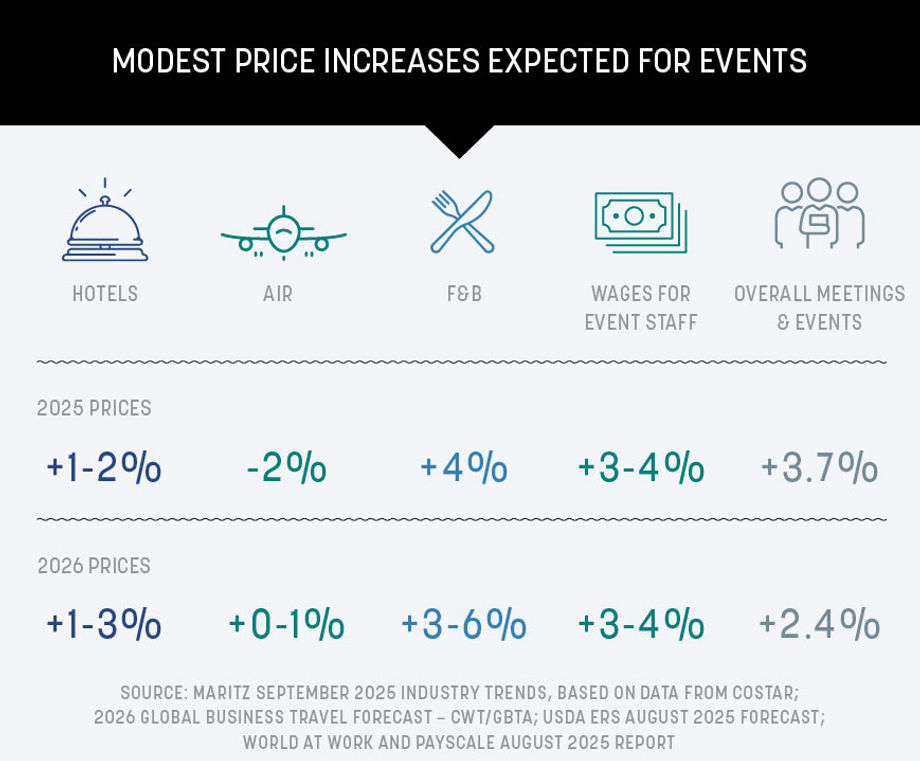
It should be somewhat reassuring, then, to note that analysts are projecting only modest growth for 2026. An average of relatively low, single-digit price increases are expected for hotels, airfare, food and beverage, and event-staff wages in the coming year, according to the Maritz September 2025 Industry Trends report. The third-party planning giant expects average overall cost increases of just 2 to 4 percent through 2026, in line with inflation rates and general economic conditions.
That generally aligns with cost-per-attendee expectations, according to the Amex GBT forecast, which found 38 percent of event professionals anticipating slight increases. Just 6 percent of respondents expect costs per attendee to rise significantly (by 11 percent or more).
Planners have adjusted expectations so as not to strain budgets, according to the PULSE Survey: Just 23 percent anticipate producing more meetings in 2026 than in 2025, the lowest percentage to anticipate volume growth in at least three years. Attendance expectations are softening as well, with 40 percent of planners expecting declines of at least 10 percent in 2026.
A cooling hotel market
CoStar and Tourism Economics, both of which provide lodging data analytics, have downgraded the previous projections for U.S. hotel growth a couple of times this year. The U.S. lodging market has continued to underperform as larger concerns about the economy persist; lower international inbound travel has affected a number of destinations, as well.
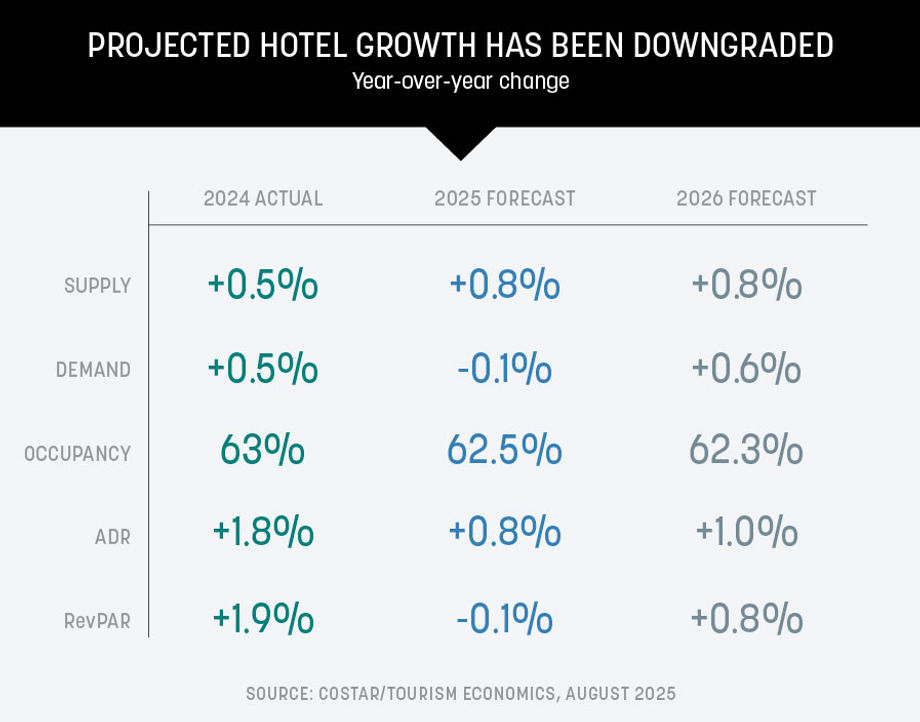
In August, the lodging specialists lowered expectations in their most recent updated forecast, reducing projected demand for the year by 0.6 percentage points, average daily rate by 0.5 percentage points and revenue per available room by 1.1 percentage points. Similar downgrades were made for the 2026 projections.
In September, hotel occupancy fell year-over-year for the seventh consecutive month, and it is likely that the next forecast update later in November will lower expectations once again for this year and next.
Still, planners probably won't have the negotiation leverage they might expect from such a scenario. Breaking down the forecast by chain scales reveals why: The luxury and upper-upscale chain scales — the hotels that typically have meeting space — are faring far better than all of the chain scales below them. What's more, the properties are successfully raising rates to offset occupancy shortfalls.
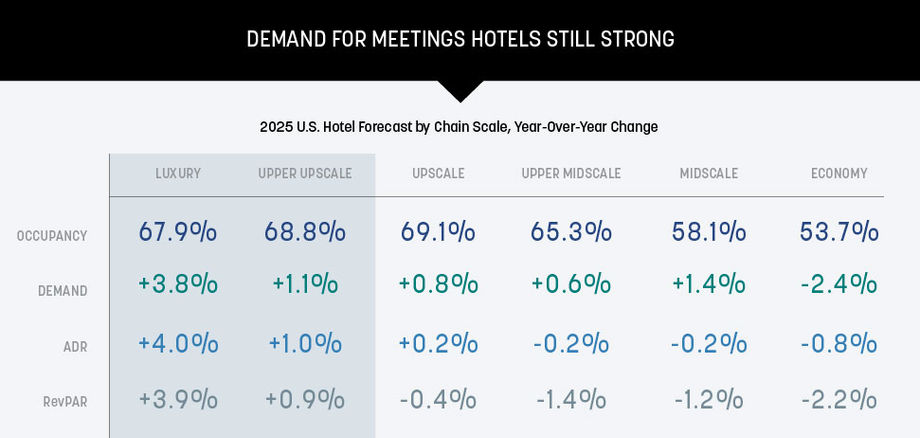 CLICK THE IMAGE TO SEE THE 2026 U.S. HOTEL FORECAST BY CHAIN SCALE, WITH. YEAR-OVER-YEAR CHANGES.
Economic uncertainty also has put hotel construction projects on hold, meaning there won't be new supply of hotel meeting space anytime soon to offset demand. In September, the volume of U.S. hotel rooms under construction dropped year-over-year for a ninth consecutive month. Of the projects that are under construction, only 19 percent of the rooms are for hotels in the luxury or upper-upscale categories.
Steady growth for exhibitions
Business-to-business exhibitions should see steady growth overall, according to the 2025 CEIR Index Report, which estimates 2.5 percent annual growth this year and another 2.3 percent increase in 2026.
While the industry has been on a positive trajectory post-pandemic, CEIR, an exhibition-related research firm, doesn't expect it to recover to its 2019 benchmark in 2026 or 2027.
Not surprisingly, the recovery timeline is highly dependent on market sectors. Trade shows with more than 200,000 net square feet are performing well and are on track to match prepandemic levels by next year, according to the report. Five industry sectors recovered in 2024: building, construction and home repair; transportation; raw materials and science; financial, legal and real estate; and food.
On the other hand, the uncertainty stemming from policies such as the tariffs likely will hit some sectors more significantly, and economic headwinds have clouded the outlook for those sectors. Industries such as manufacturing and construction, for instance, could be challenged in 2026. Technology exhibitions, particularly those related to artificial intelligence or web services, are expected to perform well. Final 2025 results will be published when CEIR's next index publishes in April/May 2026.
Incentives face headwinds
Incentive travel should remain flat in 2026 and is expected to show modest growth in 2027, according to the latest research. The Incentive Travel Index, produced by the Incentive Research Foundation and the Society for Incentive Travel Excellence, released in October, revealed that incentive professionals are concerned over rising costs and global instability, and their optimism levels are dropping. The index findings mirror the results of the April 2025 Northstar/Cvent Incentive PULSE Survey, which polled 210 North American incentive planners.
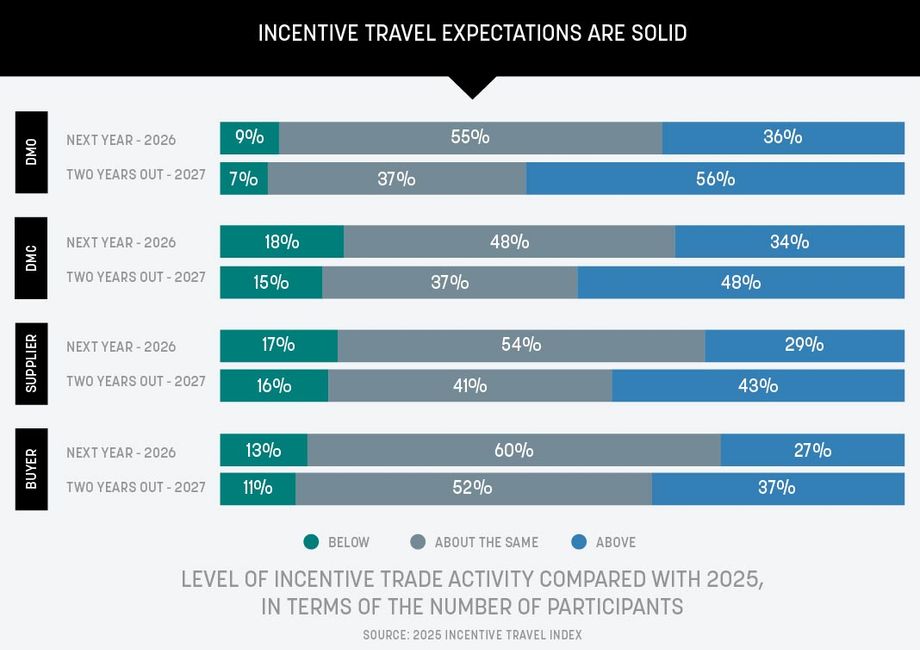
"While 75 percent of respondents agree that the value of incentive travel remains strong, they also say the business gets tougher every year," said IRF president Stephanie Harris. "Incentive professionals are under pressure to deliver more with less — without compromising quality or impact."
The index, which polled 2,700 global incentive professionals, showed that planners expect to spend more next year on hotels, airfare, and food and beverage.
According to the Incentive PULSE Survey, 30 percent of those polled said their 2026 incentive travel budgets will be lower than 2025 budgets. More planners report reduced budgets than increased budgets.
Diving deeper
Other trends for 2026 and beyond from the Incentive Travel Index include:
- More than one third of buyers will trim costs in 2026 by paring down gifts, choosing less-expensive destinations or shortening their program lengths.
- The top short-term challenges incentive professionals face, per the index, are increased costs and inflation, followed by international instability, uncertainty, and political considerations. Rising costs also are a worry for the long term, as are attracting and retaining industry/hospitality talent, and securing an adequate budget to deliver their programs.
- The vast majority of those polled have adopted AI, with content creation, and destination research and planning cited as the top uses.
- Twenty-five percent of buyers expect to improve their programs in 2026; the top upgrades mentioned were in accommodations and activities.
- On the destination front, planners are seeking out places they haven't used before: 63 percent of those queried have booked new destinations for their 2026 or 2027 programs.
- Of the different industries that use incentive travel, pharmaceuticals and health care are expected to have the biggest rise in activity in 2027 compared with 2025 levels.
— Lisa A. Grimaldi