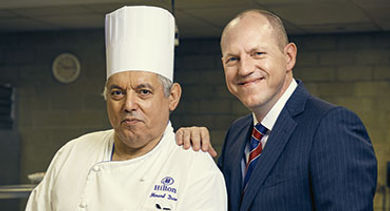
Laurens Zieren, general manager of the New York Hilton Midtown, has always employed a "management-by-walking" style. It allows him to stay connected to the hotel's many departments, from laundry to F&B, and acknowledge workers when they do a good job. This summer, to celebrate the hotel's 53rd anniversary, he's expanding this recognition strategy -- with the help of technology.
Every day for the next 365 days, Zieren will choose a different hotel employee -- with a particular focus on those who work behind the scenes and aren't traditionally guest-facing -- to honor in an Instagram post, using the hashtag #ChiefRecognitionOfficer.
"This is something that I've done for years on a very informal basis," says Zieren. "The emergence of social media technology has enabled me to make this recognition more meaningful. I embrace this opportunity wholeheartedly."
Technology is changing the face of recognition. We'll take a look at the emergence of recognition tech, plus three more trends playing a role in the next evolution of engaging employees.
The Generational Model
"Many generational award trends have not changed in decades," says Rob Danna, senior vice president of sales and marketing at West Des Moines-based global engagement solutions provider ITA Group. "Younger generations steer toward concert tickets, waterparks, and tuition credits. Generation X loves electronics, cookware, and charitable donations. And the Boomers grab luggage, travel packages, and company store items."
Even so, Danna believes new trends are emerging, such as career advancement and certifications that are motivating younger generations. "At ITA Group, says Danna, "we offer financial counseling, nutrition coaching, and sabbaticals -- awards that transform employees into happier and healthier people. There's nothing more motivating than receiving tools that help improve your life."
According to Peter Hart, CEO at the Montreal-based incentive management solutions provider Rideau Recognition Solutions, "Older workers still value the soft symbolism for 'years of service' more than younger workers who have just joined the company." While these often take the traditional form of certificates and pen sets, he says. "We've seen company shares being issued, depending on years of service, with taxable benefits."
But the experts agree that simply "clocking in" the employee's tenure at previously set intervals (five years, 10 years, etc.) does not really work, and may even cause friction between members of the older generations, who've paid their dues, and younger ones, who want their rewards tied to significant achievements. Or, as Danna puts it, "Leaders should treat their team like they are professional athletes coming off the court at halftime. What would you give your MVP for setting the scoring record?"
In the past, human resource departments have attempted to resolve tenure disparities by loading all recognition and rewards into a points-based program. But, according to Hart, "A lot of the folks with 15-plus years of service started complaining that there was nothing symbolic that represented years or service."
He thinks one answer is to move the goalposts. For the youngest generation, "the average tenure is about three years. We believe that it's important, once you pass that probationary period, that there's an onboarding award," Hart says. "There's an award at one year. There's an award at three years. And then five, 10, 15 . . . ."
It's also important to recognize the behaviors and activities that lead to achievement. "A lot of programs are structured as 'you're the best of the best, and you get this.' But more and more, companies are recognizing the path -- the road -- to achievement. And that road includes the behavior of wanting to learn, and then going out and practicing it."
For this reason, the new trend for incentive programs is to establish "best practice" norms for the company -- a trend that, supports social recognition within an organization and allows employees the freedom and power to recognize one another, anytime, anywhere, according to David Brennan, general manager of the Toronto office of Achievers, an incentive software solutions company. Thus, he adds, "The frequency of recognition and rewards is tied to employee behavior and success -- not their age, or any other demographic factor."
Danna agrees, with one caveat: "Multigenerational workforces have one thing in common: winning. Everyone is motivated when they are respected. They feel safe when the team is winning." Awards should remind them of these cultural attributes (respect, safety, winning).
"Regardless of the generation, recognition is a basic human need. People want to come to work happy and leave happy," says Derek Irvine. In addition to being vice president of client strategy and consulting for Globoforce, an international provider of social recognition solutions working with Fortune 500 companies like The Hershey Company, Cisco Systems, and Symantec, he wrote the book The Power of Thanks: How Social Recognition Empowers Employees and Creates a Best Place to Work with Globoforce CEO Eric Mosley. Especially across generations, Irvine says, "employees should be recognized frequently and in a timely and human manner -- make sure the recognition moment closely follows the act that is being recognized to ensure the act is top-of-mind."
Say It with Tech
It may be a cliché to state a problem, then say, "There's an app for that." That doesn't mean it isn't true. Each of the organizations whose experts were interviewed for this story offers a tech answer for all the data mining, surveying, and tagging that goes into the backend of an incentive program.
"Achievers has invested in best-in-class mobile app technologies and innovations to unite employees and drive desired behaviors," says David Brennan, general manager of the Toronto office of Achievers. "The Achievers recognition and rewards platform is purposefully designed to be highly social, mobile, and interactive. In addition to our feature-rich mobile application, we incorporate recognizable social elements across the platform -- including our recognition newsfeed, ability to socially interact with recognitions through Likes, comments, or boosts, and the public leaderboards -- allowing the recognition to become that much more powerful, and to promote a shared corporate culture."
Rideau offers recognition applications that deliver a one-stop shop from strategy, design, and marketing to training, program management, and analysis. Its interface integrates with company data to set recognition birthday and service reminders; track earned points and redeemed rewards to allow employees to choose rewards, nominate employees for awards; and customize certificates, cards, and other reward elements. Peter Hart, CEO of Rideau Recognition Solutions, uses his company's technology: "I can recognize somebody with an e-card, and it doesn't matter if he's working here in the Montreal head office or our New York office or New York distribution office. You have technology that makes them feel part of the team."
The Globoforce Mobile app provides a complete mobile peer-recognition experience on a mobile device. In addition, the company creates global employee recognition programs for clients like The Hershey Company, with its more than 22,000 employees in 17 different countries. "Hershey wanted to offer peer-to-peer recognition, provide mobile access, and offer a standardized experience for all employees that allowed for worldwide recognition," says Irvine. As a result of the program in 2015 the SMILES program (the name Hershey chose) achieved 81 percent of recognition across different countries, and employee engagement scores increased 11 percent.
The ITA Group (which also says it has invented a science called Motivology) has over 20 unique recognition programs all consolidated on one platform, says Rob Danna, senior vice president of sales and marketing for ITA Group. "Today, many workers have 25 log-ons for their initiatives and no clue where to turn if anything goes wrong," he says. "Recognition systems should not compete with your intranet. They need to be an app hanging off your intranet. And they need to be consolidated in one place."
In fact, Danna offered an insight into his own best practices at work: "In the morning, I open up our intranet to learn about what is going on, then I click on Strive5, our consolidated recognition system, to see what I can do today to align with the organization.
"Today we're offering sign-ups for weekend volunteers and offering new e-learning courses. If I do an interview with Incentive magazine, I'll earn 50 points! Talk about loyalty and alignment."
Getting Away from the Hive
Disharmonies between reward and recognition further amplify as the "hive model" for corporations becomes less relevant. While having workers report to a corporate headquarters and its various satellites remains the norm, certain job functions are now done by a growing cadre of remote employees.
"At ITA Group," says Danna, "we noticed in the late 1990s [that] we saw more people working outside of HQ; some never even saw their manager. But we still wanted them to be part of our culture, so we began adding communications and reward strategies that allowed for recognition of behaviors -- from peers as well as managers. After all, you still deserve recognition for a good act, even if your manager didn't see it."
Recognition, says Irvine, "gives you an incredible capability to build relationships that transcend time and place." Social recognition programs offer human resources managers the benefit of pulling distributed and remote workers back into the collegiality of a workplace through the visibility of recognition moments. "This includes companies with far-flung offices and remote workers," he adds.
For Hart, there's a difference between urban workers and outliers. "There's a big difference between rural and urban," he says. "If you're living in a city, we tend to live in a cynical world. But if you leave, it becomes less cynical. I can tell you, if you're a bank manager, and you're in a small town, you're a bigwig. They take pride in having those symbols that say, 'Okay, I'm at this status.'"
According to Brennan, the actual rewards that people choose to receive don't seem to change much based on whether they work in an office, from home, or out on the road. "As long as the rewards are meaningful, the recognitions are frequent and honest, and the platform encourages adoption, the entire organization stands to benefit through increased engagement, loyalty, and shared culture."
Danna agrees that flexible workplaces and workers are now the norm and should be treated no differently than on-site ones. "Technologies have evaporated the walls and distances between us. Therefore, a solid strategy will work everywhere for everyone."
It should still be as personal as possible, adds Hart. "Sometimes we'll try to schedule a presentation when I'm visiting them, or they're coming here, to make it special. The last thing we want to do is put an award in the mail. You've heard the expression, 'Your check is in the mail.' Well, an award in the mail doesn't really cut it for us. We try to make it as personal and special as possible. And that should be a rule that everyone abides by."
The Eye of the Beholder
Recognition, says Hart, is an emotion: "You either feel appreciated or you don't." He adds, "Over 90 percent of companies have recognition programs, yet, according to the Gallup Organization, over 60 percent of employees don't feel truly valued or appreciated."
Checking employees' collective pulse is integral to incentive programs. According to Irvine, in a survey from Globoforce's WorkHuman Research Institute, 85 percent of U.S. workers said that being recognized made them feel more satisfied in their jobs and 81 percent said they felt more committed to their company. Even so, says Irvine, "The continued strong economy presents a challenge to companies as increasing job opportunities mean employees will be more tempted to pursue new jobs, and have higher expectations of their current company."
In fact, a strong economy can be the greatest test of an incentive program. "Your high-potential team members always have options, but as economies improve, it's your top talent that is most transient," says Danna. Which makes it important to recognize them -- in every sense of the word. "A-Players put up the numbers in sales (or whatever their capacity), but they also volunteer in the community, participate in wellness programs, and do extra-curricular learning. That's why traditional manager spot awards and peer shout-outs aren't enough anymore."
Danna maintains that the best loyalty reward strategies blaze the trail for pioneers to follow. Successful loyalty programs feel good to participate in because the person chose to participate on his or her terms. "They were given choices on what to align with -- not told or mandated."
Brennan agrees, saying, "The most motivating reward an organization can offer its employees, regardless of age or demographic, is one that is meaningful and personal to them. Offering employees a choice in how they want to be recognized for their valuable work is a powerful tool to drive engagement and business results within the company."
Questions or comments? Email [email protected]
This article appears in the July/August 2016 issue of Incentive.