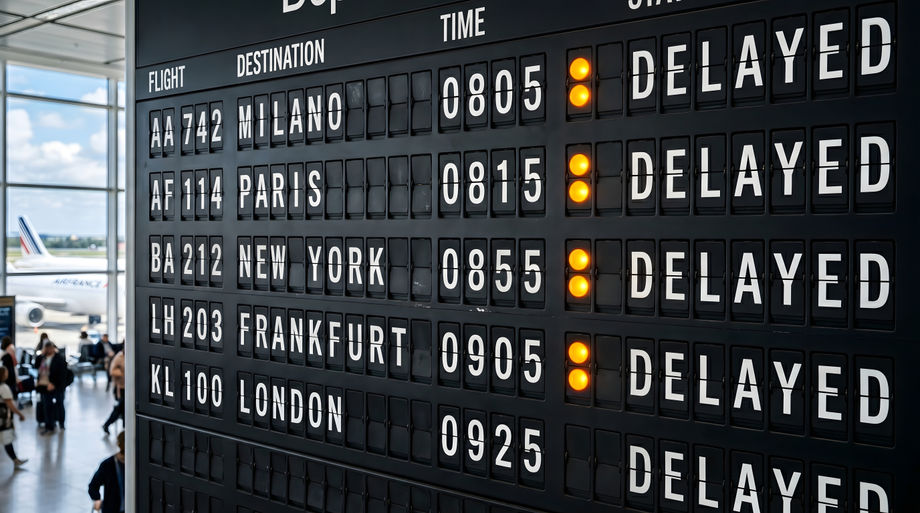
 For planners managing attendee travel, the rule could influence both how airline reliability is measured and when travelers qualify for assistance during delays and cancellations. Photo by ATRA for Adobe Stock.
The U.S. Department of Transportation is changing how airlines report delays and cancellations, a move that could reshape airline performance statistics and affect passengers heading to meetings, and events.
Under a new final rule, effective Oct. 19, the DOT is creating a separate reporting category, known as Section 511(b), for 10 types of disruptions that historically have been counted against carriers. By removing those events from the traditional Air Carrier category, airlines could appear to have fewer controllable delays and cancellations in federal performance data, even though the underlying number of disruptions might not change.
The change matters to meeting planners not only because it could alter airline performance rankings, but also because it might affect the benefits travelers receive when flights are disrupted. The DOT acknowledged that passenger amenities and compensation are expected to decline because many carriers tie benefits such as meal vouchers, hotel accommodations and other assistance to disruptions deemed within the airline's control.
In practical terms, travelers might be less likely to qualify for airline-provided compensation during certain disruptions.
10 categories deleted
Historically, the Air Carrier category has included delays and cancellations attributed to factors within an airline's control, including crew shortages, maintenance issues, fueling delays, boarding problems and other operational challenges. The new Section 511(b) category removes 10 specific events from that classification:
- Aircraft cleaning following a passenger death
- Aircraft damage caused by extreme weather, foreign object debris or sabotage
- Baggage-system outages not controlled by the airline or its contractor
- Cyberattacks, provided the airline complied with applicable cybersecurity requirements
- Unexpected government system failures or shutdowns
- Overheated brakes resulting from emergency-safety procedures
- Certain nondeferrable, unscheduled maintenance issues
- Medical emergencies not caused by the airline
- Removal of unruly passengers
- Airport closures caused by volcanic ash, wind or wind shear
The change was mandated by the FAA Reauthorization Act of 2024 and is intended to align federal reporting with congressional direction that these events should no longer be treated as airline-controlled disruptions.
What it means for airline performance data
The change could complicate year-over-year comparisons of airline performance. Because some delays and cancellations that previously counted against carriers will now be reported in a separate category, future DOT statistics might not align directly with historical performance data. Airlines could show fewer controllable delays and cancellations without any corresponding reduction in the total number of flight disruptions.
That distinction is particularly important for meeting planners, travel managers and event organizers who use the DOT's on-time performance data when evaluating preferred airline partners.
Cyberattacks get special treatment
One of the most notable additions is cyberattacks. Under the rule, delays and cancellations stemming from a cyberattack will no longer be considered airline-controlled if the carrier was complying with applicable cybersecurity regulations. As airlines and airports contend with a growing number of technology outages and security incidents, this category could become increasingly significant in performance reporting.
A bigger change could be coming
The FAA Reauthorization Act also requires the DOT to create a separate category, or categories, to identify and track delays and cancellations resulting from FAA Air Traffic Control System instructions. The department said it plans to address that requirement through a future rulemaking process.
That action could prove even more consequential, because it could provide greater visibility into disruptions caused by air traffic–control staffing shortages, ground stops, traffic-management initiatives and other FAA operational constraints.