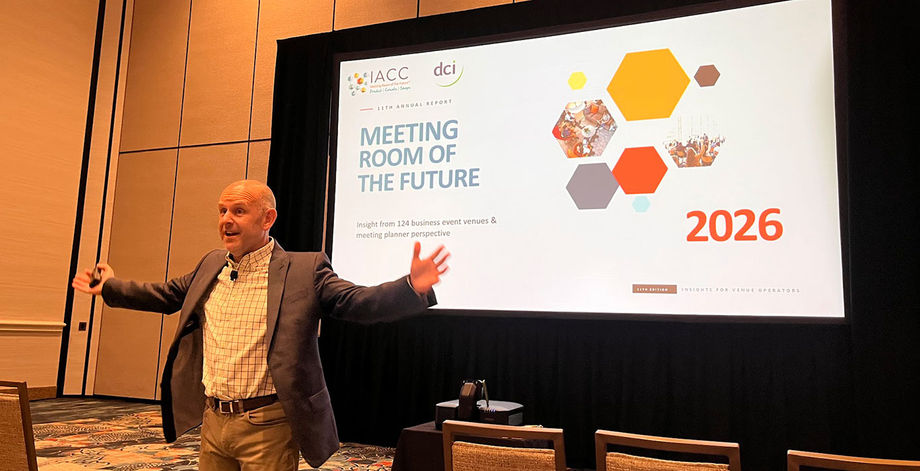
 Mark Cooper, CEO of IACC, presents this year's Meeting Room of the Future report at IMEX. Photo Credit: Alex Palmer
Live events are now where companies build their culture, and venues are being asked to support this goal. That was the message IACC CEO Mark Cooper brought to IMEX America this week when he walked an audience through the association's 2026 Meeting Room of the Future report.
The research, released in June, draws on a survey of 124 conference venues across North America, Europe and Asia Pacific. Cooper's interactive session, part of the Smart Monday education program created by Meeting Professionals International, paired the data with anecdotes that planners in the room shared with the audience.
"Culture used to be built in the office. It's now built in the meeting room," said Cooper, pointing to conversations he had this spring with people from dozens of organizations, such as J.P. Morgan and Novartis.
With the office no longer the hub of working life that it once was, Cooper learned that "now the role of the live event is to develop organizational culture — not to make sure that the event embodies a preexisting organizational culture."
How are venues responding?
This new focus puts pressure not just on the meeting planners, but on the venues. More than two-thirds of those surveyed said they are responsible for "experience creation," led by themed food and beverage (92 percent) and team-building (87 percent), as well as team-based sporting activities (71 percent) and well-being experiences (70 percent).
Cooper also highlighted how menus are getting personal, with 89 percent of venues reporting more dietary requests, and 57 percent seeing attendees drinking less alcohol (rising for a third year running, and reaching 70 percent in Asia Pacific). Cooper emphasized that planners should expect dietary needs to be the norm rather than the exception.
He also highlighted how attention spans just keep getting shorter, marked by comments from venues that programs are continuing to shift away from long, theater-style sessions in favor of the use of breakout rooms and informal spaces for networking and workshops. Cooper noted that 64 percent of the venues said they have added lounge seating in 2026, and that a growing number of venues are moving to 100 percent flexibility (from 30 percent last year to 36 percent this year), meaning all the meeting rooms have been filled with with furniture and equipment that allow flexible layouts..
What are planners seeing?
Cooper opened up the conversation to query the planners in the room, asking them to describe a conference or business-event venue that impressed them in the last year. One audience member described a site that provided a hospitality area for the sponsors and planner, delivering service to all stakeholders, even beyond the attendee. Another pointed to a venue that delivered a luncheon themed around creativity, complete with bread shaped like an edible painter's palette and a choreographed performance by the waitstaff.
Cooper emphasized that because meetings are taking on a growing role in shaping company culture, when organizations do gather, it is to work through complex challenges — not the easy ones that could be taken care of with an email. For that reason, he said it's more important than ever that "the environment is one that promotes creativity. Unless you free the mind in that way when you're in a venue or a location, really difficult questions aren't going to get answered."