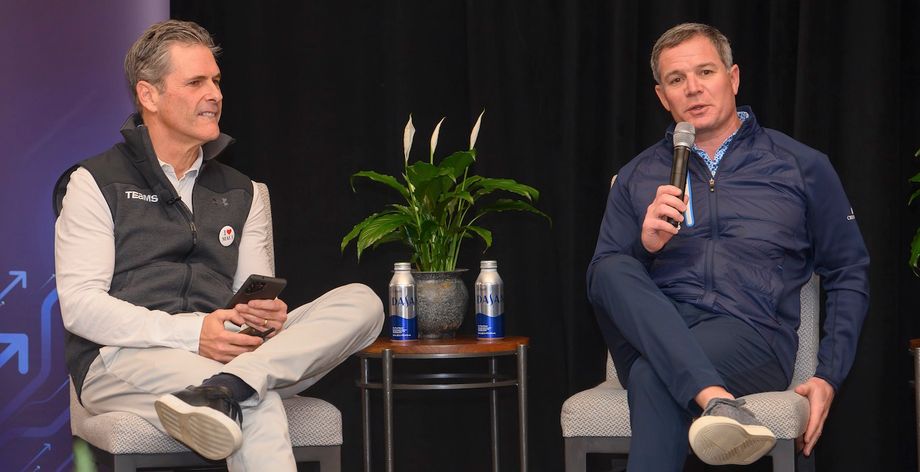
 Northstar Meetings Group executive vice president David Blansfield (left) interviews U.S. Travel Association CEO Geoff Freeman at Leadership Forum. Photo Credit:Michael Troutman, DMT Imaging
The trillion-dollar travel industry is plagued by a lack of recognition and respect among business leaders and policymakers in the United States, according to Geoff Freeman, CEO of the U.S. Travel Association. That invisibility has led to sustained inaction by the federal government, and a failure to fix the problems stunting the segment’s economic potential and growth, he added.
Freeman discussed these hurdles and outlined U.S. Travel’s action plan during Northstar Meetings Group’s annual Leadership Forum at Pebble Beach in Monterey, Calif. Following are highlights from his conversation with Northstar executive vice president David Blansfield.
The U.S. travel industry has faced various challenges over the years. What's the key change needed now?
While the travel industry has been resilient, we need to approach it with a deeper understanding of its nuances. What works for one segment of the business may not necessarily work for another. We must recognize and navigate these distinctions to truly represent the industry effectively.
Are there general actions we can take to benefit the industry overall?
First and foremost, we need to wake up every day and prove the essential nature of this industry. Unlike certain manufacturing industries, the travel industry doesn't enjoy the same assumed respect. We're often discarded, and that perception needs to change.
Secondly, we must focus on improving the process of getting from point A to point B. More than 20 percent of flights are delayed or canceled, and we're facing shortages in air traffic controllers, impacting the overall travel experience.
What role can the federal government play in supporting the travel industry?
Look at the current situation: It takes months to get a passport or a visa, and the delays extend to programs like Global Entry and TSA PreCheck. We're facing hurdles in convenient travel to Canada and Mexico. When you look at these problems collectively, it feels like a giant middle finger from someone. The federal government needs to step in, streamline these processes, and reauthorize the Federal Aviation Administration to address these challenges comprehensively.
The international landscape has its own set of challenges. How does U.S. Travel plan to address them?
We've outlined three priorities: protecting and growing new markets, pinpointing specific agendas for each segment (group, transit, business, and domestic leisure) and executing concrete plans. We're focusing on each segment individually. Starting with group travel, we've brought in experts like Ishma Haider, formerly with Visit Orlando and before that with Caesars, to lead the way. The idea is to have dedicated teams for each segment, with a specific focus on driving and protecting their interests. As we learn and succeed in one area, we plan to expand this model to cover other segments as well.
The pandemic has significantly affected international inbound travel, particularly from countries like China and Japan. We're currently at 70 percent of prepandemic visitation but only about 65 percent of prepandemic spending. To recover and grow, we need to adapt and innovate. It's about not just reclaiming lost ground, but also charting a course for sustainable growth.
Any final thoughts on the overall strategy for U.S. Travel?
It's about coalescing the industry, being aggressive in our focus, and accumulating more points on the board. The journey starts with a dedicated approach to each segment, proving the value of travel day in and day out. We're excited about the prospects, and it's crucial that we all come together to steer the industry toward a brighter future.