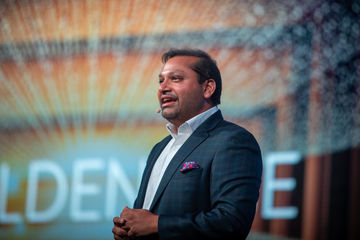
Artificial intelligence is poised to revolutionize a variety of industries, and the world of event planning is no exception. Planners have heard as much ad nauseam for more than a year now, and they're desperately craving more examples and specifics. During a recent webinar session I moderated at Event Tech Live in Las Vegas, industry thought leaders Adam Parry, Tess Vismale, and Brandt Krueger shared insights on how AI is transforming the way meeting professionals work — and the specific tools they can leverage to stay ahead of the curve.
Parry is the cofounder of Event Tech Live; Vismale is the founder and CEO of iSocialX, and an event technologist and educator; and Krueger is senior production manager of EideCom. You've likely run into some or all three of them at industry events, seen them on webinars or heard them on podcasts. Each has worked to elevate industry education, particularly around event technology. I encourage you to check out the webinar for their unique insights and an in-depth discussion about how we can and should be using these tools. Meanwhile, we wanted to highlight here the AI tools and platforms we called out during the program — some of which I used to put together this article, which I will explain below.
AI tools you can use
One of the most popular AI tools discussed was ChatGPT, an advanced language model developed by OpenAI. Planners can use ChatGPT to generate content for session agendas, press releases and promotional materials. While the free version of ChatGPT requires well-crafted prompts to achieve optimal results, paid plans allow users to create custom GPTs that can be trained on specific data sets, ensuring more accurate and tailored outputs. While a few event professionals are sharing custom GPTs as part of educational programs, the panelists believe that planners will increasingly be using their ability to write custom GPTs as a competitive advantage in the industry.
For those new to AI-assisted content creation, tools like Jasper.ai offer a user-friendly alternative. Jasper.ai is designed specifically for content creation by enterprise marketing teams, providing premade prompts and templates that cater to the needs of event marketers. Other content-optimization tools mentioned include Grammarly and Wordtune, which help refine written content by suggesting improvements in tone, length and clarity.
Beyond content creation, AI tools are being used to streamline various aspects of event planning. Krueger highlighted the potential of AI in accelerating the RFP process, with tools like ChatGPT being used to summarize lengthy RFP documents and generate quick responses. This would allow both planners and suppliers to respond to RFPs more efficiently, potentially giving them a competitive edge — as long as all important points are double-checked in the actual document. Remember, AI-generated summaries can often contain inaccuracies, regardless of the platform being used.
Vismale emphasized the importance of viewing AI as a personal assistant that can help tackle overwhelming tasks and generate ideas for automations. By leveraging AI to map out thoughts and ideas, planners can save time and focus on higher-level strategic thinking. Tools like Spark AI, designed specifically for events by Gevme in collaboration with PCMA, can provide valuable insights and alternative perspectives on event design and execution.
When it comes to event-specific AI tools, Parry introduced Congo, an upcoming platform in beta that brings AI-powered conversation analysis to in-person events. By recording and analyzing conversations at trade show booths, Congo aims to help exhibitors capture and retain valuable information from their interactions with attendees. While tools like this potentially could be very valuable to exhibitors, the implementation of such technologies could well raise concerns about privacy and data security among attendees — which event organizers would need to address through transparent communication and clear opt-in policies.
Other AI tools mentioned during the webinar
- Midjourney and DALL-E: These are powerful image generation tools that can create custom graphics and visual assets for events. DALL-E is made by OpenAI and the latest version is available to all paid ChatGPT subscribers.
- Fireflies, Otter and Fathom: These AI-powered meeting transcription and summarization tools can help planners capture and distill key insights from event-related discussions and videos.
- Suno: The AI-driven music-generation tool can create custom soundtracks for events, potentially reducing the need for licensed music or live performers.
- Snapsight by Gevme: This AI-based real-time content-summarization tool is designed to be used during events to capture and distill session highlights. The inaugural Meetings Show Asia Pacific recently debuted the latest version of this technology and produced a white paper of content highlights from the entire show, available just days after the event.
- Claude: A generative-AI platform from Anthropic, this tool can produce content with a different cadence and tone than ChatGPT, favored by Vismale, as well as by many journalists. The paid version can handle a variety of attachments.
- Gemini 1.5 and Copilot: The latest generative-AI platforms come from Google and Microsoft, respectively. While Gemini's image-generation features specifically have been the source of some controversy, some are praising its fast analytic capabilities. Microsoft Copilot might be especially attractive to enterprises that rely on Office products, particularly for using OneDrive files as a dataset. For enterprise users, the data isn't used to train Copilot for general use (nor to train OpenAI, of which Microsoft is a major investor).
- Bardeen and Zapier: These are workplace-automation platforms that use AI to address repetitive tasks on an enterprise level.
- Descript: This AI-driven tool allows you to edit audio or video based on moving and cutting words in the transcript produced by the platform.
Play with all of the AI tools
As the events industry continues to embrace AI, it is crucial for planners to stay informed about the latest tools and technologies. But all of the panelists emphasized that AI should be viewed as an assistant rather than a replacement for human expertise. By leveraging AI strategically, planners can streamline their workflows, generate fresh ideas, and deliver more engaging and efficient events.
To stay ahead of the curve, event professionals should continuously explore and experiment with AI tools, share knowledge within their professional networks, and prioritize transparency when implementing AI-powered solutions. By doing so, planners can harness the power of AI to up their games and create truly memorable experiences for their attendees.
I used a couple of AI tools to repurpose this webinar content before editing and adding quite a bit of information myself. I ran the audio file through Otter to produce a transcript, and then uploaded that transcript to Claude with the following prompt:
"Please analyze the following webinar transcript and repurpose it as 1,000-word article that identifies all of the AI tools mentioned during the webinar and describes each one. The article should be based on the title "AI Tools for Planners to Up Their Game." The tone should be journalistic and appropriate for a trade publication that creates content for people who plan meetings and events."